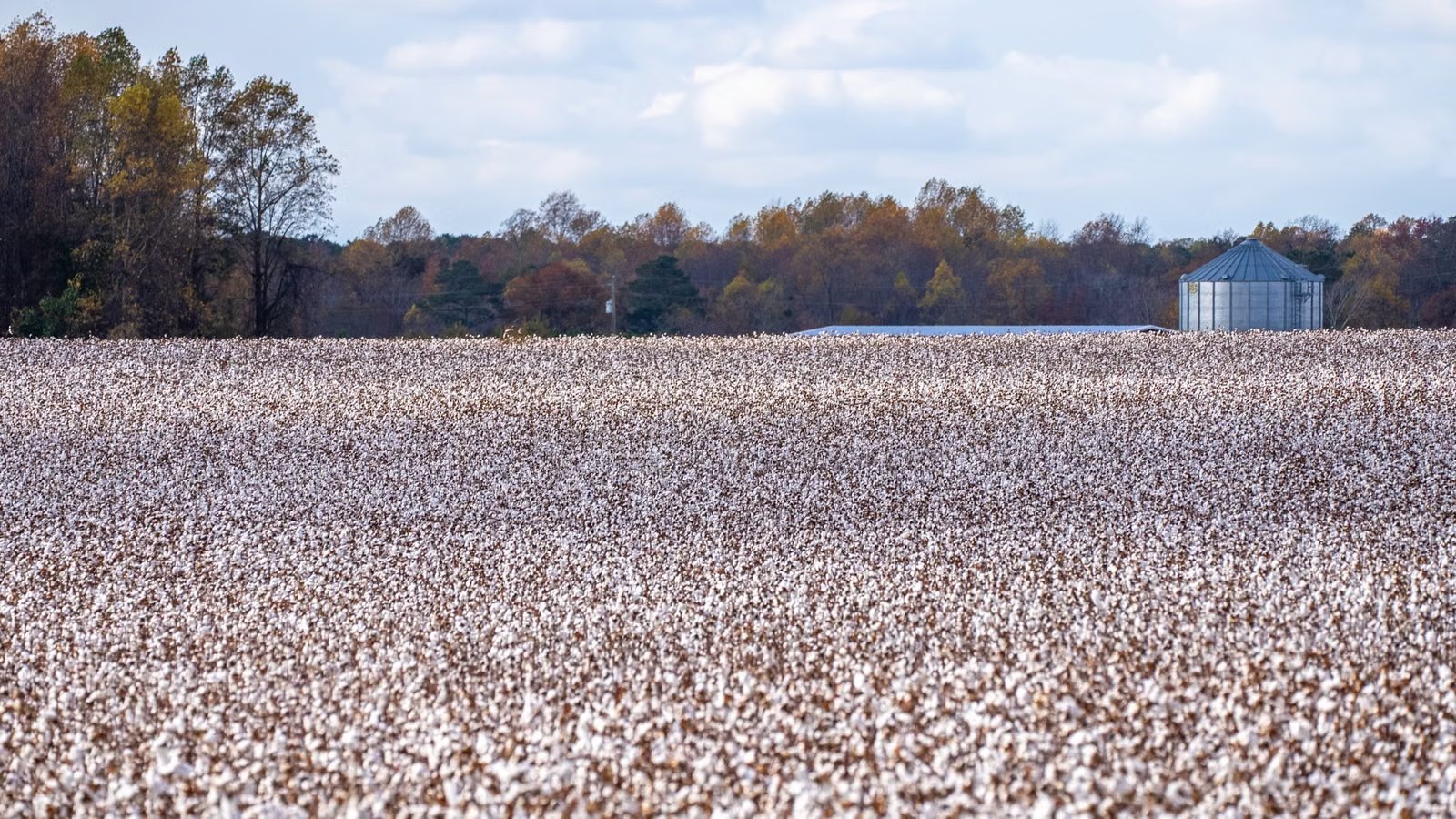
Photo by Mark Stebnicki via Pexels, free to use under the Pexels License.
Quick Answer: USDA’s November 2026 forecast puts Texas cotton yield at 507 pounds per harvested acre, down from 537 pounds in October and 629 pounds in 2025. Texas production is projected at 4.143 million bales against 5.265 million last year, on 3.925 million harvested acres. Nationally, cotton is forecast at 13.175 million bales with a season-average farm price of 76 cents, up sharply from 62.2 cents a year ago.
How bad is the 2026 Texas cotton crop?
Measured by yield, it is the worst in recent memory for the state that grows most of America’s cotton. USDA’s November forecast puts Texas yield at 507 pounds per harvested acre. That is 30 pounds below the October forecast and 122 pounds, or 19.4 percent, below the 629 pounds achieved in 2025.
Production follows yield. Texas is projected to produce 4.143 million bales in 2026 against 5.265 million bales in 2025, a decline of 1.122 million bales or 21.3 percent. Harvested acreage of 3.925 million acres is described as slightly below last year’s level, which means essentially the entire production shortfall comes from yield rather than from acres.
| Measure | November 2026 forecast | October 2026 forecast | 2025 actual |
|---|---|---|---|
| Yield per harvested acre | 507 pounds | 537 pounds | 629 pounds |
| Production | 4.143 million bales | Not stated | 5.265 million bales |
| Harvested acres | 3.925 million | Not stated | Slightly higher |
The rest of the southern Plains is worse off in yield terms. Kansas cotton yield is projected at 499 pounds per acre and Oklahoma at just 300 pounds. For a region where cotton acreage runs to the horizon, a 300-pound Oklahoma yield is close to the threshold at which harvest decisions become marginal.
Why did yields fall so far?
Weather, and the Dallas Fed’s own survey of agricultural bankers documents it directly. In the third-quarter 2026 Agricultural Survey, collected from 50 Eleventh District agricultural bankers between September 1 and 9, respondents reported deteriorating conditions across most of the district, with heat and lack of rain negatively affecting yields.
The survey records ranchers culling or considering culling cattle herds because of dry grazing conditions, and notes that despite rising commodity prices, concerns about profitability endure as input prices remain elevated and yields stay weak. Many producers continue to rely on crop insurance. One respondent described extreme drought and excessive heat as having greatly hampered all crops and livestock production.
That last point is the one West Texas lenders and equipment dealers should sit with. Crop insurance converts a yield disaster into a revenue event rather than a solvency event, but it does not generate the discretionary spending that a good year produces. A 507-pound crop paid partly through indemnity does not buy new cotton strippers.
What is happening to the national cotton balance sheet?
The November World Agricultural Supply and Demand Estimates put U.S. all-cotton production at 13.18 million 480-pound bales for 2026/27, down from 13.44 million in the October projection and 13.90 million in 2025/26. National yield fell 15 pounds from the previous forecast to 775 pounds per harvested acre.
| Item | 2024/25 | 2025/26 est. | 2026/27 Oct | 2026/27 Nov |
|---|---|---|---|---|
| Planted, million acres | 11.18 | 9.28 | 10.45 | 10.45 |
| Harvested, million acres | 7.76 | 7.83 | 8.16 | 8.16 |
| Yield, pounds per harvested acre | 892 | 852 | 790 | 775 |
| Beginning stocks | 3.15 | 4.00 | 4.15 | 4.15 |
| Production | 14.41 | 13.90 | 13.44 | 13.18 |
| Total supply | 17.56 | 17.90 | 17.60 | 17.33 |
| Domestic use | 1.70 | 1.50 | 1.50 | 1.40 |
| Exports | 11.90 | 12.30 | 12.30 | 12.30 |
| Total use | 13.60 | 13.80 | 13.80 | 13.70 |
| Ending stocks | 4.00 | 4.15 | 3.80 | 3.70 |
| Average farm price, cents per pound | 63.2 | 62.2 | 77.0 | 76.0 |
Three features of that table matter for West Texas. First, harvested acreage is actually higher in 2026/27 at 8.16 million acres than in either of the two prior years, so the production decline is purely a yield story at national level too. Second, exports are unchanged at 12.30 million bales even as production falls, which means the adjustment is coming out of stocks and domestic mill use. Third, domestic use was cut to 1.40 million bales from 1.50 million.
Ending stocks are now projected at 3.70 million bales, down from 3.80 million in October and 4.15 million in 2025/26. A stocks-to-use ratio of roughly 27 percent is not tight by historical standards, but the direction of travel is clear and it is supportive of price.
Does the higher price offset the lower yield?
Partly, and the arithmetic is worth doing carefully. The season-average farm price is projected at 76.0 cents per pound for 2026/27 against 62.2 cents in 2025/26, an increase of 13.8 cents or 22.2 percent. Texas yield fell 19.4 percent, from 629 to 507 pounds.
On those two numbers alone, revenue per harvested acre works out to roughly $385 at 2026 figures against roughly $391 at 2025 figures, which is close to a wash. The problem is that the cost side did not cooperate. The Dallas Fed survey explicitly notes input prices remaining elevated alongside weak yields, which is why bankers reported continuing profitability concerns despite increasing commodity prices. A roughly flat gross revenue per acre against higher costs per acre is a margin squeeze.
It is also worth noting that the October projection had the price at 77.0 cents and November trimmed it to 76.0 cents even as production fell. The market is not paying up one-for-one for a smaller crop.
What is happening to West Texas farm credit?
Contracting on both sides. The Dallas Fed Agricultural Survey reports demand for agricultural loans continued to decline in the third quarter while the availability of funds continued to increase. The rate of loan repayment decreased at a pace similar to the prior quarter. Loan renewals or extensions dropped for the first time since 2023, and loan volume declined compared with a year earlier across all loan categories.
Credit standards tightened further, and interest rates ticked up for all loan types in the quarter. At the same time, the anticipated trend in farmland values index jumped again, implying respondents expect farmland values to rise.
Land values themselves were mixed. Real values for dryland, irrigated land and ranchland all declined in the third quarter, though district values remained up year over year for dryland and ranchland while down for irrigated land. Real cash rents pulled back for all three categories.
Why are bankers worried about acreage disappearing?
Because it is being bought for something else. The survey records ag bankers’ concern about the disappearance of agricultural land to increased competition from other commercial developments, with one banker describing agriculture as slowing down while significant acreage is converted to data centers and alternative energy sources.
That is a structural observation, not a weather observation, and it cuts directly across West Texas. The same flat, cheap, sunny and windy land that grows dryland cotton is the land that solar developers, wind developers and now data center developers want. When cotton yields 507 pounds an acre and a lease payment arrives regardless of rainfall, the comparison is not close for a landowner weighing options.
It also explains the apparent contradiction in the survey: declining real land values alongside an expectation that farmland values will rise. Values based on agricultural income are under pressure while values based on alternative use are not.
What does this mean for gins, warehouses and exporters?
Volume is what pays the cotton infrastructure chain, and volume is down. A gin earns per bale ginned, a warehouse per bale stored and a compress per bale handled, none of which benefit from a higher price on a smaller crop. Texas producing 4.143 million bales instead of 5.265 million means roughly 1.12 million fewer bales moving through that chain in a single season.
The national figures show where the squeeze lands hardest. Exports are held at 12.30 million bales for 2026/27, unchanged from both the October projection and the 2025/26 estimate, while production falls to 13.18 million. With beginning stocks of 4.15 million and total supply of 17.33 million, the balance is maintained by cutting ending stocks to 3.70 million and trimming domestic use to 1.40 million bales.
Domestic mill use at 1.40 million bales is worth isolating. It was 1.70 million in 2024/25 and 1.50 million in 2025/26, so the figure has fallen 17.6 percent in two years. U.S. mills now consume barely a tenth of the crop. Texas cotton is an export commodity, and its economics are set in Pacific shipping lanes rather than in American textile plants.
That export dependence cuts both ways for West Texas. It insulates the region from weak domestic apparel demand, and it exposes the region to tariff policy, currency moves and foreign mill demand, none of which a Lubbock producer can hedge in the way they can hedge price.
How does cotton sit within the Texas economy overall?
As a regionally concentrated industry inside a large and diversifying state economy. Texas total nonfarm employment reached 14,469,300 in August 2026, up 159,400 jobs or 1.1 percent over the year, with mining and logging at 212,400, construction at 924,900 and manufacturing at 982,800. Agriculture does not appear in nonfarm payroll data at all, which is precisely why cotton’s weight in West Texas is routinely understated in statewide statistics.
The relevant comparison is not cotton against the Texas economy, but cotton against the alternatives for the same acre. With dryland yields at 507 pounds, farm loan renewals falling for the first time since 2023 and bankers watching acreage convert to data centers and renewable generation, the 2026 crop year is the kind that accelerates decisions landowners were already weighing.
How does the regional labor market look?
Steadier than the crop data would suggest, which is a reminder that West Texas metros are no longer purely agricultural economies. Texas Workforce Commission estimates for August 2026 show Lubbock with a civilian labor force of 188,200, employment of 180,800 and a not-seasonally-adjusted unemployment rate of 3.9 percent, unchanged from a year earlier.
| Metro | Labor force | Employed | Unemployment rate | Rate a year earlier |
|---|---|---|---|---|
| Lubbock | 188.2 | 180.8 | 3.9% | 3.9% |
| Amarillo | 139.9 | 134.7 | 3.7% | 3.5% |
| Abilene | 90.0 | 86.7 | 3.7% | 3.8% |
| San Angelo | 62.2 | 60.0 | 3.6% | 3.7% |
| Wichita Falls | 66.0 | 63.2 | 4.2% | 4.1% |
| Texas | 15,967.7 | 15,231.9 | 4.6% | 4.6% |
Every West Texas metro in the table sits below the 4.6 percent state rate except Wichita Falls at 4.2 percent, which is still below it. San Angelo at 3.6 percent and Abilene and Amarillo at 3.7 percent ranked second, third and fourth lowest among all Texas metropolitan areas in August, behind only Midland at 3.3 percent.
That resilience is the practical answer to anyone reading a 21 percent cotton production decline as a regional crisis. Agriculture drives land values, equipment sales, gin employment and rural main street spending, but the metro labor markets of Lubbock, Amarillo, Abilene and San Angelo are now anchored by health care, education, logistics, manufacturing and energy. A bad cotton year is a serious problem for producers and their lenders without being a metro-level recession.
Frequently asked questions
How much cotton will Texas produce in 2026?
4.143 million bales, per USDA’s November 2026 forecast, down from 5.265 million bales in 2025, on 3.925 million harvested acres.
What is the Texas cotton yield this year?
507 pounds per harvested acre, down from 537 pounds in the October forecast and 629 pounds in 2025. The national average yield is 775 pounds.
What is the cotton price outlook?
USDA projects a season-average farm price of 76.0 cents per pound for 2026/27, up from 62.2 cents in 2025/26, though trimmed from 77.0 cents in the October projection.
Are farm loan conditions tightening in West Texas?
Yes. The Dallas Fed’s third-quarter 2026 Agricultural Survey reported declining loan demand, falling repayment rates, tighter credit standards, higher interest rates across loan types, and loan renewals dropping for the first time since 2023.
Are West Texas farmland values rising or falling?
Real values for dryland, irrigated land and ranchland all declined in the third quarter of 2026, though dryland and ranchland remained above year-ago levels. Bankers nonetheless expect farmland values to rise.
Which Texas metros have the lowest unemployment?
Midland led at 3.3 percent in August 2026, followed by San Angelo at 3.6 percent and Abilene and Amarillo at 3.7 percent, against a statewide rate of 4.6 percent.
Sources and Further Reading
- World Agricultural Supply and Demand Estimates, report 677, November 2026 — U.S. Department of Agriculture
- Texas Cotton Yield Falls Again In November Forecast, November 2026 — RFD-TV
- Agricultural Survey, Third Quarter 2026 — Federal Reserve Bank of Dallas
- Civilian Labor Force Estimates for Texas Metropolitan Statistical Areas, August 2026 — Texas Workforce Commission